

Publications

Emergent Universal Drag Law in a Model of Superflow
Despite the fundamentally different dissipation mechanisms, many laws and phenomena of classical turbulence equivalently manifest in quantum turbulence. The Reynolds law of dynamical similarity states that two objects of same geometry across different length scales are hydrodynamically equivalent under the same Reynolds number, leading to a universal drag coefficient law. In this work we confirm the existence of a universal drag law in a superfluid wake, facilitated by the nucleation of quantized vortices. We numerically study superfluid flow across a range of Reynolds numbers for the paradigmatic classical hard-wall and the Gaussian obstacle, popular in experimental quantum hydrodynamics. In addition, we provide a feasible method for measuring superfluid drag forces in an experimental environment using control volumes.
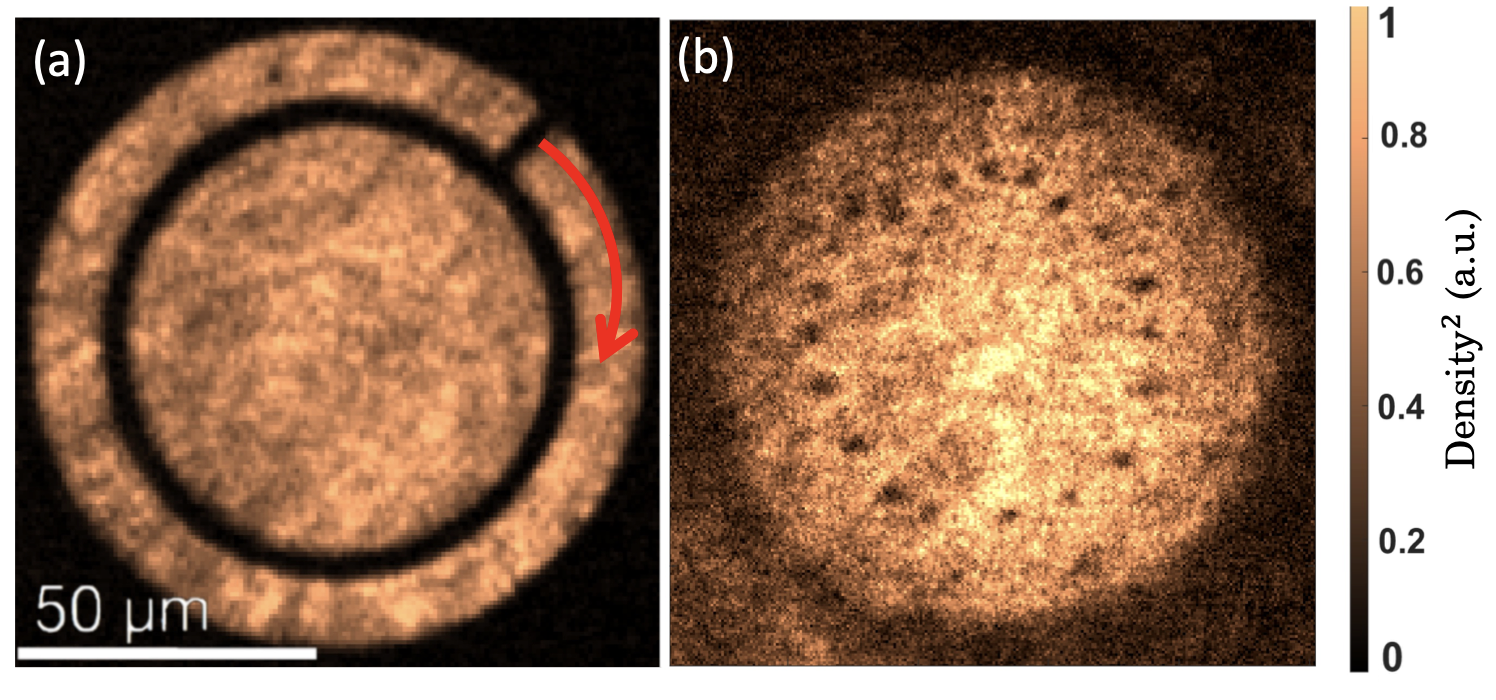
Shear-Induced Decaying Turbulence in Bose-Einstein Condensates
We study the creation and breakdown of a quantized vortex shear layer forming between a stationary Bose-Einstein condensate and a stirred-in persistent current. Once turbulence is established, we characterize the progressive clustering of the vortices, showing that the cluster number follows a power law decay with time, similar to decaying turbulence in other two-dimensional systems. Numerical study of the system demonstrates good agreement of the experimental data with a point vortex model that includes damping and noise. With increasing vortex number in the computational model, we observe a convergence of the power-law exponent to a fixed value.

Optimizing persistent currents in a ring-shaped Bose-Einstein condensate using machine learning
We demonstrate a method for generating persistent currents in Bose-Einstein condensates by using a Gaussian process learner to experimentally control the stirring of the superfluid. The learner optimizes four different outcomes of the stirring process: (O.I) targeting and (O.II) maximization of the persistent current winding number and (O.III) targeting and (O.IV) maximization with time constraints. The learner optimizations are determined based on the achieved winding number and the number of spurious vortices introduced by stirring. We find that the learner is successful in optimizing the stirring protocols, although the optimal stirring profiles vary significantly depending strongly on the choice of cost function and scenario. These results suggest that stirring is robust and persistent currents can be reliably generated through a variety of stirring approaches.

Turbulent Relaxation to Equilibrium in a Two-Dimensional Quantum Vortex Gas
M. Reeves et. al
Phys. Rev. X 12, 011031
In this work, we explored the relaxation of initially non-equilibrium configurations of vortices. Impressively, the vortex configurations in equilibrium were found to closely match the predictions of the point vortex model.

Roadmap on Atomtronics: State of the art and perspectivecs
M Baker et al, 2021
AVS Quantum Sci. 3, 039201 (2021)
Roadmap on Atomtronics: State of the art and perspective, has now been published online in AVS Quantum Sci. 3, 039201 (2021). This is a review of the latest progress in atomtronics-enabled quantum technologies, such as matter-wave circuits and atom chips.

Dynamic high-resolution optical trapping of ultracold atoms
Gauthier Guillaume et al, 2020
Advances In Atomic, Molecular, and Optical Physics Volume 70, 2021, Pages 1-101
Our review of configured optical trapping techniques for cold atoms has been posted on the arXiv. We have aimed for a detailed technical review that highlights some of the subtleties in implementing acousto-optic deflector, DMD and SLM traps, as a complete guide to the experimentalist. The chapter will appear in Advances in Atomic Molecular and Optical Physics later this year.