
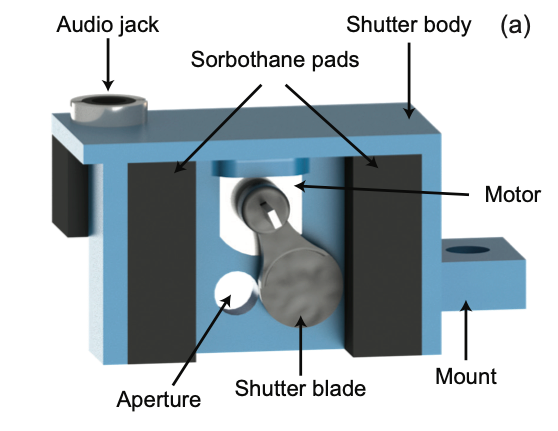
A high-speed, large-aperture 3D printed laser shutter for cold atom experiments
Cold atom experiments require optical shutters with rapid and repeatable actuation. Existing solutions often involve high cost, limited aperture diameter and slow transitioning. We present a 3D-printable shutter design featuring a large aperture of 4.5 mm diameter, low-cost assembly, and robust performance. The device achieves switching times of 399±8 μs with delays of 2.7±0.2 ms for a fully illuminated aperture, with four different shutters demonstrating repeatable performance. We measure the shutter speed to be 7.0±0.1 m/s. This approach offers an accessible, scalable solution for cold atom and other optical experiments requiring multiple shutters with precise light control and avoids the need to resize or precision-align a beam through an aperture.

Melting of a vortex matter Wigner crystal
The two-dimensional One-Component Plasma (OCP) is a foundational model of the statistical mechanics of interacting particles, describing phenomena common to astrophysics, turbulence, and the Fractional Quantum Hall Effect (FQHE). Despite an extensive literature, the phase diagram of the 2D OCP is still a subject of some controversy. Here we develop a "vortex matter" simulator to realize the logarithmic-interaction OCP experimentally by exploiting the topological character of quantized vortices in a thin superfluid layer. Precision optical-tweezer control of the location of quantized vortices enables direct preparation of the OCP ground state with or without defects, and heating from acoustic excitations allows the observation of the melting transition from the solid Wigner crystal through the liquid phase. We present novel theoretical analysis that is in quantitative agreement with experimental observations, and demonstrates how equilibrium states are achieved through the system dynamics. This allows a precise measurement of the superfluid-thermal cloud mutual friction and heating coefficients. This platform provides a route towards solving a number of open problems in systems with long-range interactions. At equilibrium, it could distinguish between the competing scenarios of grain boundary melting and KTHNY theory. Dynamical simulators could test the existence of predicted edge-wave solitons which form a hydrodynamic analogue of topological edge states in the FQHE.